Computational design of multifunctional bioactive glass nanoparticles: A multi-objective optimization approach to balance osteogenesis, anticancer activity, and antibacterial efficacy
DOI:
https://doi.org/10.66224/jcc.7.1.7Abstract
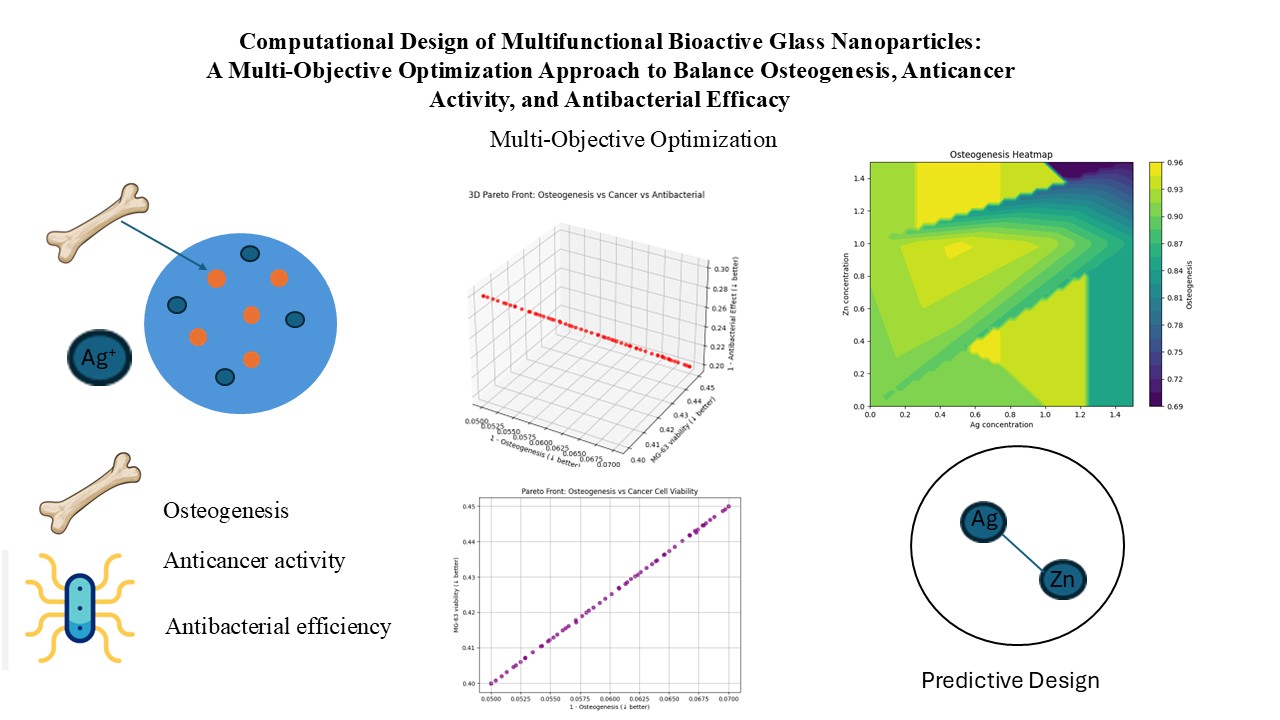
Developing multifunctional biomaterials that can simultaneously support bone regeneration, suppress tumor growth, and prevent infection is still a major challenge in treating bone cancer. Naruphontjirakul et al. recently showed that bioactive glass nanoparticles co-doped with zinc and silver (Zn/Ag-BGNPs)-, specifically the 0.5Ag–1Zn and 1Ag–1Zn formulations-demonstrated encouraging triple functionality: osteogenic differentiation in hFOB 1.19 cells, selective cytotoxicity against MG-63 osteosarcoma cells, and broad-spectrum antibacterial properties while remaining non-toxic to hFOB 1.19 cells at a concentration of 125 µg/mL. The design of such materials has focused on empirical methods with little systematic consideration of the trade-offs between competing biological objectives. Therefore, in this study, we develop and implement an innovative data-driven multi-objective optimization framework that utilizes the entire experimental data set from the study noted above, to identify Pareto-optimal Ag/Zn compositions. By predicting an Ag-Zn effect that favored one composition over another, this study provides a rationale for the predictive design of multifunctional biomaterials—a study that demonstrates that high-performance therapeutic platforms can be optimized computationally without new experimentation, thereby increasing the speed for clinical translation to orthopedic applications in bone regeneration.
Published
How to Cite
Issue
Section
License
Copyright (c) 2025 .

This work is licensed under a Creative Commons Attribution 4.0 International License.

