Wearable biosensors incorporating nanocomposites: advancements, applications, and future directions
DOI:
https://doi.org/10.61882/jcc.6.4.6Abstract
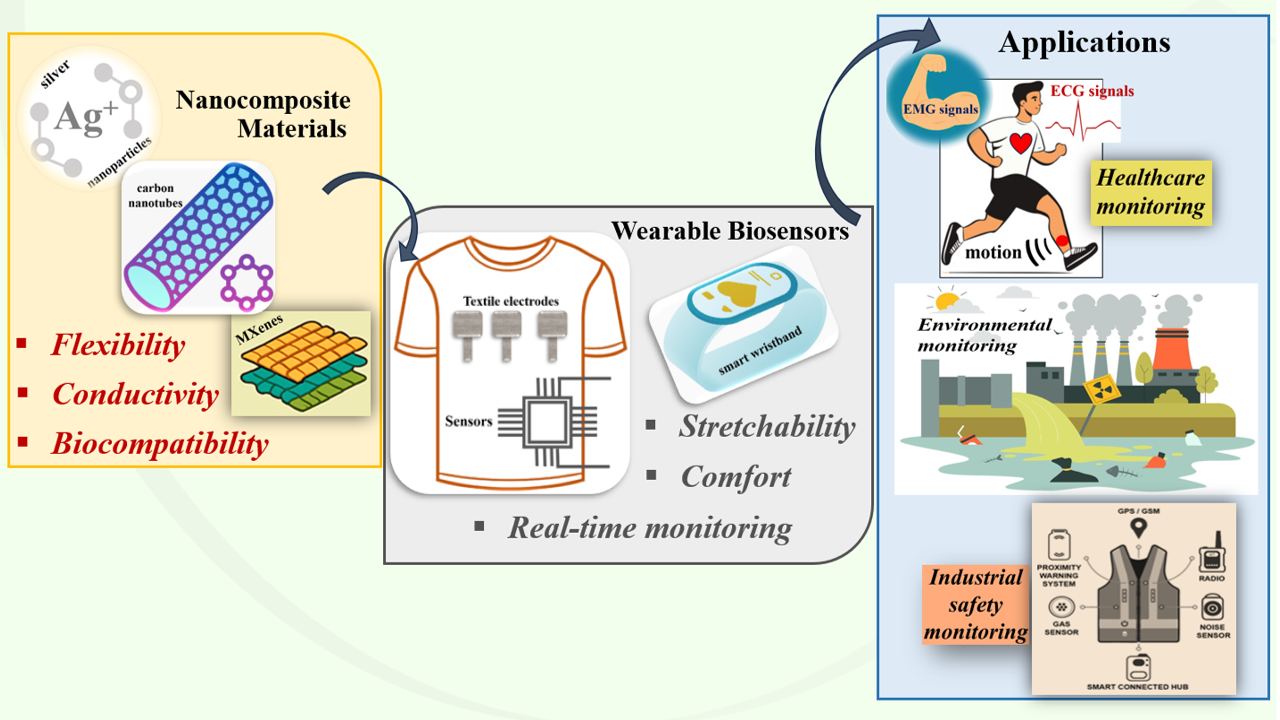
Wearable sensors have emerged as transformative tools, enabling real-time monitoring of human health and activities. Within this field, miniaturized and flexible devices have attracted significant attention due to their compact size, ease of use, and non-invasive operation. These sensors function by detecting biological activities and converting bio-signals such as electrophysiological, mechanical, and biochemical information into quantifiable data. Such data can be obtained through various sensing approaches, including the detection of electrolytes, ions, and gases. In many cases, wearable sensors are fabricated by integrating the sensing element into a polymer matrix, with nanomaterials playing a particularly important role in enhancing performance. Health monitoring remains the primary application area for these devices. Emerging technologies, including AI-assisted sensing and cloud-based data processing, are expected to drive future advancements, while also introducing challenges related to data privacy. Looking ahead, key areas of development for nanomaterial-based wearable sensors include non-contact monitoring, textile-integrated devices, and improvements in security and regulatory frameworks.
Published
How to Cite
Issue
Section
License
Copyright (c) 2024 .

This work is licensed under a Creative Commons Attribution 4.0 International License.

